In Diane Setterfield’s Gothic suspense novel, The Thirteenth Tale, daughter of a bookstore owner, Margaret Lea, and Vida Winter, the famous English novelist, set out on an incredible adventure digging into Ms. Winter’s past in order to produce her first true biography. I’ll start by telling you that Vida Winter is not her real name. And that is the least interesting part of this incredible story. As a lover of books, I’ve read quite a few in this genre and never has one presented a plot twist as remarkable as this one. If this book were just now being published, I think its Gothic charm and eerie story line could make for an excellent book trailer. If I were running the show, this is how I would do it:
If this trailer intrigues you, please go out and buy the book. If you’re not a book lover, but the plot still appeals to you, check out BBC’s adaptation of the novel. I haven’t watched it myself, as I learned about it today, but it’s next on my list!
Twin brothers Jack and Finn Harries host the British YouTube channel JacksGap, which currently has more than 4 million followers. The channel was launched in 2012 as a result of an idea Jack had – to record the twins’ “gap year,” or the time taken to travel and self-explore between high school and college (or college and the real world). After the immediate success the channel had, the twins decided to push back college even further to “nurture the little brand [they]’d created.”1
The aim of the project was to tell the stories of their adventures through film and share them through their channel. The idea was born “from a love of travelling and storytelling.”2 Additionally, the channel has become a platform through which the twins raise awareness about causes they believe are important.
The project expanded in 2013 when they launched the JacksGap website to feature content that wasn’t suited for YouTube, such as written content and photographic records of their travels. Most importantly, the website has a tab called “Participate” where users have a forum to strike up conversation about topics they feel should be explored by the twins.
The channel features a few recurring sections:
Shed Sessions
In Shed Sessions, the twins collaborate with other YouTubers to feature a band that they admire. Shot in their perfectly British shed in the backyard, the band and their instruments squeeze in for a very intimate acoustic performance. Their video of Skinny Living singing their song “The Journey” gave me goosebumps!3
24 Hours in…
In this section, Jack Harries attaches a jerry-rigged camera to his head (via a bicycle helmet and some tape) and records every waking moment of 24 hours in a new city. Some locations include Tokyo, New Orleans, and Istanbul. Simply put, they are beautiful. These kinds of videos feature very little, if any talking. Jack isn’t on camera at all (seeing as how he’s wearing it). The videos aren’t about the selfies and the mad cool adventures these boys have – they’re about keeping record of what they saw and sharing their experience. They seem to embrace the world with such an open and humble mindset; like they are just one small part of this world and they want to experience it as much as they can. Everything they do is so artfully and thoughtfully done. A close up shot of the calloused soles of Philippine children’s feet as they play basketball in the street.
The strangely human face of a monkey in a hot spring in Tokyo.
And Others
Like The Good Collective, Following Heart, and dozens of other unique postings, most everything else they do is very globally minded. They ask themselves, and their audience, Big Picture anthropological questions, such as what do we all believe in? What do people all across the world fear?
They also have fun, handy DIY things like “The Jack Knife Hack,” which transforms a Swiss army knife into a place to store all your keys.
Jack and Finn Harries are visual storytellers who rarely spend more than 3 minutes actually in front of the camera. This is what makes them different from so many other YouTube celebrities. Their celebrity isn’t rooted in how attractive they are, or their amazing giveaways. They have over 4 million followers because they portray the world we live in so beautifully and with such a unique, humble point of view that people want to see everything they have to show us. But their gloriously trendy hair and British accents don’t hurt…
Check them out on YouTube, their website, and (my personal favorite) Instagram to see whichever incredible location their project has taken them to next.
Had a lovely chat with the host of Reflections of Three Broke Travelers, Lindsey Yanow, about my new podcast How to Adult!
Tell me a bit about your podcast!
How to Adult is meant to teach young adults that a) it’s okay that you don’t know what the f*&/ you’re doing or where you’re going right now and b) most people would say that they’re in exactly the same boat. Maybe you graduated college, backpacked around Europe working in bars, played your music at open mics, blew through your savings, came back to the States, and had to move in with your parents. You may be wondering what to do next, but you’re not a loser. You’re a struggling, soulful millennial – though some people would say those are the same.
What does “adulting” mean to you?
Adulting means understanding the reality that, unlike our parents, many of us are graduating college without the guarantee of a job. We flounder, get creative with the next steps of our lives, and adapt. It means that, but it also means that your twenties are a learning curve into true adulthood, and here are some pieces of advice to help.
How will it be structured?
Each week, How to Adult will post a podcast about one issue that young adults can either relate to, in the form of a personal narrative, or more “how-to” style pieces that offer concrete, yet entertaining, advice on day-to-day topics.
What can listeners expect from your podcast?
Future listeners can expect for their host to not be an all-knowing, incredibly accomplished, I-have-arrived adult. I am qualified to be the host because I am not qualified for much else. Kidding, but you get what I mean. I am a graduate student whose rent is on her parents’ dime and anxiously awaits the day when I consider myself a real adult.
What initially drew you to this topic?
Laughing with my grad school friends (ages 22-31) about how none of us consider ourselves real adults (even though many of them actually are). I thought there were a lot of funny stories there, but also a lot of fun service-type information to produce.
6. What do you see for the podcast in the long term?
I see it maybe turning more into narrative-style, embarrassing, relatable anecdotes and less service oriented. But I think young adults love quick tips on “How to Do X Better!” so I don’t think that aspect will ever go away.
Christopher Kimball hosting America’s Test Kitchen Radio
An experiment of podcast reviewing in three different formats!
Publisher’s Weekly Listens to America’s Test Kitchen Radio
Based in Boston, host Christopher Kimball and culinary expert Bridget Lancaster introduce listeners to the fascinating world of America’s Test Kitchen. Home to more than three dozen full time cooks and kitchen-gear testers, ATK tests recipes and products again and again to give their listeners the most informed scoop of what’s on the market in the world of kitchen gadgets. In these podcasts, Kimball starts by meeting with recipe testers to taste test something listeners have called in and asked about – such as doing a comparing brands of brown rice to find the best on the market. Then listeners can call in and speak to Kimball and Lancaster about their latest culinary dilemma, to which the hosts always have an answer. ATK features experts and interesting figures in the culinary world today before rounding off the episode with more call-in question. If you’re obsessed with Food Network and want to continue learning about the best kitchen gear and recipes, ATK radio is for you.
Tweet tweet
ATK Episode 505 – I’ve never been able to get on the brown rice train, but I actually liked the ATK tested Lundberg brand with your recipe!
Brought to you by National Public Radio, a review of America’s Test Kitchen Radio
[soundcloud url=”https://api.soundcloud.com/tracks/248773682″ params=”auto_play=false&hide_related=false&show_comments=true&show_user=true&show_reposts=false&visual=true” width=”100%” height=”450″ iframe=”true” /]
Based in Boston, host Christopher Kimball and culinary expert Bridget Lancaster introduce their listeners to the fascinating world of America’s Test Kitchen in their podcast: America’s Test Kitchen Radio. During the show, listeners call in and speak to Kimball and Lancaster about their latest culinary dilemma, to which the hosts always have an answer. Christopher Kimball is a well known American chef, editor, publisher, and TV and radio personality. He is a regular contributor to NPR and is currently the editor and publisher of Cook’s Illustrated and Cook’s Country magazines. Let’s not forget Bridget Lancaster, executive food editor for TV and radio of Cook’s Country magazine. Her career led her to work in various kitchens in the South and Northeast; concentrating on pastry. Please check them out on America’s Test Kitchen Radio – Recipes that work.
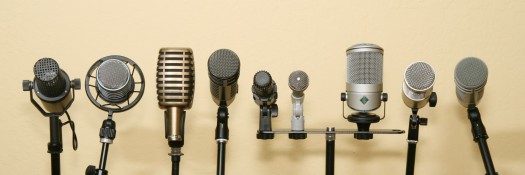
Ultimate Podcasting Mic Shootout by Matthew McGlynn
1. History
Originally coined “audioblogging” (thank God they changed that), podcasting began in the 1980s. However, broadband Internet and mp3 devices like the iPod allowed podcasts to really gain some traction in 2005. The term “podcast” is a portmanteau of the words iPod and broadcast. A podcast is defined as “a digital medium consisting of an episodic series of audio, video, PDF, or ePub files subscribed to and downloaded through web syndication or streamed online to a computer or mobile device.1”
2. Why Are They So Popular?
The main reason why podcasts are so appealing is that there is something for everyone. They are simple and easily digestible forms of content that you can put in your pocket and carry with you wherever you go. Audiobooks are appealing for this reason as well. Although, audiobooks are very expensive and require quite a bit of concentration, or risk having to back up a chapter or two every time you begin again. Say you don’t have time to read about Trump’s latest faux pas? Tune into the NPR Politics podcast for a recap.
3. The Big Ones
Serial
Sarah Koenig, as a part of This American Life, has become somewhat of a household name for her work on the podcast Serial. The first season of Serial concerns Adnan Syed, a teenager convicted for murdering his ex-girlfriend in 1999. Koenig has been posting updates to the case on Serial because Syed’s case is being reopened. Season two focuses on Army solder Bowe Bergdahl who is being charged with desertion after fleeing, being kidnapped by the Taliban and tortured for 5 years.
Stuff You Should Know
Josh and Chuck explore all those little, fleeting questions you’ve had about the world and then let them slip away because the answers seemed too complicated or unknowable to worry about. Examples of their episode titles explain what I mean: “What’s the deal with staring?” “How passports work,” and “How umami works!”
TED Radio Hour
Produced by NPR, TED Radio Hour journeys through fascinating ideas: “astonishing inventions, fresh approaches to old problems, new ways to think and create.2” These podcasts can be longer than some, but are perfect for a commute, morning routine, lunch break, or exercise session. They suck the listener in and they return to their life knowing more than when they clicked “play.”
4. What Makes Podcasts Successful?
A few things make a podcast successful. First, the channel needs a clear and easily definable niche category to claim. They need to be consistent in producing content that relates to their designated area, even if it’s something random and funny like WTF with Marc Maron. Ideally, they would also have a reason to post each week. Serial kills this aspect of podcasting by telling one story, week by week, keeping the listener hooked and salivating for the next Thursday when the next episode comes out. Or maybe that’s just me…
5. Will They Stick Around?
The Internet was to newspapers as podcasts are to the Internet. The appeal of the Internet was and is the immediacy, the brevity, and the accessibility of the information on what is happening in the world today. Podcasts take that a step further by reincorporating a human element into the delivery of that information. The human connection is important; rather than when reading an article, you feel connected to the person hosting the podcast. Like good old Sarah Koenig. Have I mentioned her? We want to hear the stories about the world around us just as much as we want to quickly consume a listicle. They’re different, but similar.
6. Won’t This Whole Podcasting Thing Just Blow Over?
I’m sure there are many people who haven’t found the perfect niche channel for them who think podcasts are on their way out; it’s simply a fad and will blow over. Well to them I would say, radio was thought to do the same thing when TV came along in the 40s and now, the radio industry is way bigger than it was back before the time of television! Anyone who loves stories and learning can love podcasts. Those interests will never go away and go back all the way to the traditions of oral story telling. However, something might come along that is an even more effective delivery method than podcasting. But for now, they’re here to stay.
7. Podcast Pros
First, most everyone can listen while doing other things: jogging, cooking, running errands, sometimes even working! Oftentimes, listening is the only form of multitasking people can do while doing other things. Second, they can be consumed on your own schedule. A lot of the niche content available on podcasts just wouldn’t work on regular radio. Not enough people would be able to tune in at the same time to make it worth the cost. With podcasts, people can search, find a channel perfect for them, subscribe, and download episodes on their own time.
8. Podcast Cons
There are many cases against podcasts in terms of the disadvantages as a medium. For example, some say it isn’t meant for complicated topics, or subjects that require visual representation to understand. Others say it is only effective for brief topics. However, I think the people who think that aren’t realizing the true potential of podcasts. If you are trying to understand kinetic energy, maybe a podcast isn’t for you – sure. But that’s applying an issue that shouldn’t be applied here. However, I do think there is one main for podcasts. It is a passive medium. In this day and age, there is a community of Internet users, and they are vocal. They like to interact, respond, dispute, argue, and praise the content that they just consumed and there isn’t really a place for that with podcasts. Usually, there is a corresponding blog or website that has links to that producer’s podcasts, as well as the App, where people could search, find, and comment there. But it feels less interactive than an article on Facebook with 1.7 million comments on it.
9. The Future of Podcasts
I can’t say where podcasts will be in 5 years. Even though the first podcast launched in 2004, it feels like they are just now really taking off and becoming a popular culture/news/entertainment medium that more people than not use. From big names like NPR and TED to small, independent producers who wanted to talk more about folklore – there are more podcasts and podcast listeners than ever before. It’s an exciting time. Let’s see what’s to follow.
I hate to admit it, but the process of integrating CSS into my simple HTML website was an extremely emotional and frustrating one. And I’ve decided that it’s all Serenity’s fault! Our professor set us up with a beautifully formatted HTML skeleton and an equally perfect corresponding CSS style sheet. Everything in these two documents were grouped and labeled for maximum manipulation and efficiency, so in playing around with it in class last week, it felt like a breeze! I was like, “Hey, self, you’re really getting the hang of this whole coding thing. Go you!”
This false esteem of mine got me thinking I was over the hurtle and landed me in the dangerous territory of excessive boastfulness.
The next day, from approximately 1 p.m. – 6 p.m., I sat alone in my apartment trying to recreate the magic from the day before. You guessed it: there was no magic in my apartment that day. I would think I was doing something completely right, but nothing was going like it should have; nothing was going according to all of my wonderful plans. I’d think I was on the right track, save, and reload my page, only to find NOTHING had changed, or worse, something horrible had happened. CTRL Z, CTRL Z, CTRL Z.
Suddenly, I thought I found a solution to one of my (many) problems! Bootstrap, whatever the heck you are, you’ve ruined my life. When building the Airbnb site through Code Academy, I could neatly trap content into little pretty columns and rows with a simple piece of code. Silly me thought I could do that on my own website. But something about using these bootstrap terms didn’t compute (puns!) and there was a period of about an hour where I was staring at my code, wondering why it worked for Airbnb, but not for me. I eventually gathered that these Bootstrap terms weren’t being recognized. I lost some hair over this issue, for sure.
When I finally emerged from my bedroom, I was a shadow of my former self.
Not having had any human interaction during the daylight hours, and constantly hitting wall after wall of errors, my spirits were broken.
Out of protest, I didn’t go back to my computer for three days, so angry and frustrated at this new language I didn’t fully understand yet. Those three days were great, ignoring the source of my rage. My confidence was back; I was feeling good.
However, I eventually returned to it, because I a) couldn’t accept defeat and b) technically had to do it for this class…but mostly the first thing.
While I didn’t solve all the kinks in my website, I have a finished product that I am very proud of after a few more hours of hard work. I did beyond what was taught in class last week and created something unique and useful! Happily ever after!
Going into this project, I considered myself a tech-savvy person. I helped my brother develop a Kick Starter; I taught my dad how to steal my mom’s audiobooks from her computer; I set my 83 year-old grandmother up with Facebook, email, and Netflix. While in this class, I have since learned that this does not make me a tech wiz.
Learning HTML and CSS is hard–like trying to learn Spanish as an adult, hard. Because essentially, that is what we’re doing: learning a new language as adults. When I confuse a <div> and a <section>, I feel the same embarrassment as when Señora Mayo scolded me in 9th grade for confusing “ser” and “estar.”
It’s a learning curve and there are bound to be some hiccups. The only major obstacle I encountered in Code Academy had to do with not understanding the context of what I was doing on a broader level: how my inserting this one line of code affects the things around it. This resulted in my often misplacing the closing tags.
Towards the end of building the Airbnb site, the task was to organize the Neighborhood Guide content into 3 columns. I inserted a <div class=”col-md-4″> around the h3 and p content that was already there. I did this three times. I put all of the closing div tags (</div>) at the end of that section of content, which resulted in an error. Realizing that each h3 section needed to be closed off with its own closing tag, I moved the up and put them around each section like this:
Code Academy
When using a <div class=”…”>, be sure you know what that command is actually doing and what it is affecting directly. This will help you remember where to place the closing </div> tags and generally help you understand the context of each line of code.
When it comes to the evolution of the Bon Appétit website, nothing has changed for the worse. Starting in 1998, the website was little more than a place people would visit to learn about subscription information. It featured the cover image of the magazine, a few links, and some staff information. There were multiple mentions of Epicurious, which was launched by CondeNet, a subsidiary of Condé Nast (of which Bon Appétit was a property). In this first iteration of the website, one banner ad at the top of the page says things like, “Tell Us Your Age” or “Do Men Find Successful Women Sexy?” To reference the “User Experience Basics” article from Usability.gov, this version of the website is not valuable, desirable, or very useful. The most useful thing about it is the recipe search bar that has been a feature of the website since the beginning.
In 2000, there was a significant design change that featured more color throughout the website, a paragraph of text related to that month’s issue, links to books written by the editors of BA, and a lot more information on subscriptions. And, thankfully, the slightly creepy banner ads were done away with. Beginning in 2001, Bon Appétit starts to create an online culinary-based community. The website now includes content that you might find in the magazine. It’s more than just the recipes now; it’s the restaurant guide, the test kitchen tips, and other useful information that BA foodies want. In 2007, their design got another huge makeover and they began featuring podcasts, giveaway sweepstakes, and BA blogs on their website.
After 10 more years of subtly tweaking the website, we have arrived at 2016 and the most modern iteration of the website. The links at the top of the page make navigating the site very easy. They help direct the user to the main departments of Bon Appétit: Restaurants & Travel, Entertaining & Style, Drinks, People, Events, Test Kitchen, Video, Recipes, and Subscribe. In addition to these departments, they have a “Popular” section that lists clickable boxes of what is being talked about most in the world of cuisine (today: labneh, matcha, gluten-free beer, cooking with kids, etc.). I think most of the advertising is branded content, or native advertising, because there are no banner ads on the website.
Overall, the website is beautiful. It features large, high-quality, colorful pictures of food surrounded by lots of white space, modern black text, and pops of yellow throughout. Additionally, the content is current and relevant while being entertaining. For example, this weekend, they had an article called “What We’re Cooking This Blizzardy Weekend,” which is hilarious to my fellow Northeasterners who are struggling through Storm Jonas. In terms of their special elements, Bon Appétit’s videos are not integrated into the endless scroll of the site. There is a section called BA Videos and links to their popular series: “BA Test Kitchen,” “Shot and a Beer,” “Celebrity Chefs,” and “All Videos.” I like this style of organization because I prefer a site that isn’t cluttered and over-stimulating. If you want to see the videos, you have to click to view them and it loads quickly.
The mobile version of the site is also excellent. It has a drop down menu with a list of all of their departments and an endless scroll of the same information on the website such as clickable articles, swipeable slideshows of recipes they’re currently cooking, photo essays of what vegetables are in season, etc.
On both the desktop and mobile sites, the emphasis on social media is strong. They strive to create a BA community and it’s evident with their use of Instagram and their RSVP section. They have snapshots of their most recent social media posts and call it “BA Social.” They are most active on Facebook and Instagram. Instagram is a great platform for them because of the spectacular photos they always feature. In addition to social media interaction, they also have a great user community because of the RSVP section, which is the longest-running column in the magazine. Say you go to a restaurant and have the best roast duck of your life – you email Bon Appétit and tell them about the dish, they hunt it down, test it in their kitchen, and it’s either featured in their magazine or they just email you back the recipe. They do multiple RSVPs per issue.
I’m so excited to see how the website has grown and evolved over the years. I think Bon Appétit performs extremely well as a website in addition to being a well-loved magazine. They make smart choices in terms of design and not over cluttering the site. The helpful links at the top to their main departments help organize the site in a way that is clear and effective. The aesthetic of the site is fresh and fun. I love to see how they’ve taken a food magazine consisting of mostly recipes and, through the website, created a little microcosm of everything foodies, like me, love to know about.
My name is Claudia Arden Stringer. I was named after Shakespeare’s mother Mary Arden, which is somewhat of a betrayal to my deep-rooted Irish heritage. To make up for it, I Irish step danced until I was 15 and have been to Ireland over 10 times. In undergrad, I was president of my university’s only student-led a cappella group the Crimson Chords. When I’m a real adult, I want to be a restaurateur or a food writer. Watching, aiding in, or writing about the creation of a beautiful dish is my greatest passion.
In order to be a top-notch food writer for a magazine or an online publication, I need to learn a few things about digital publishing:
I would like to understand the best methods of gaining a following on a food blog beyond the couple hundred that may find me by chance.
I want to be able to recognize the ideas that would make a successful story.
I need to explore other writing styles and learn how to write in the short, quippy, attention-grabbing way that the Internet and its users demand.
I’d also like to learn about the construction and design of websites because I generally lack knowledge in this area.
Finally, I want to learn the best ways to use links in articles and how best to optimize the benefits of linking.
My various interests are rooted in extremely different disciplines and each requires a different skill set that I’ve worked hard to acquire. This, and my desire to constantly learn and advance my skills, is why I will rock Emerson’s WLP program.






You must be logged in to post a comment.