The History and the Future of the Nook

Barnes and Noble released the first Nook e-reader in November 2009 for $259. It was the first time that an e-ink display was coupled with a small color LCD screen. It distinguished itself from the Kindle by allowing one to use the color touchscreen to navigate between menus and view things in full color. It had both WIFI and 3G.
From 2009 to late 2010, Barnes and Noble invested heavily in its online ecosystem. It formed relationships with major publishers through its bookstore business to ensure that B&N would have access to their digital wares and this, in turn, added more books to its online portfolio. B&N quickly attained over one million titles in the first year and captured 20% of the entire ebook market.

Eight weeks before Christmas in 2010, Barnes and Noble introduced the Nook Color. They sold millions of units in the months leading up to the holidays and sold 1 million ebooks on Christmas Day alone. They were the first big company to produce a six-inch full color Android Tablet that had its own customized user-interface. It was billed as an e-reader instead of a tablet.

The Nook Color sold more units than anything else Barnes and Noble has ever sold before in its 40 year history. The company made agreements with Best Buy and other big box retailers to put the products on the shelves. In early 2011, the Barnes and Noble App Store went live.

However, during Barnes & Noble’s 2013 fiscal year, NOOK segment’s revenue plummeted 16% to $780.4 million. Even though the sales of content on the NOOK jumped 16% between 2012 and 2013, the company suffered heavy losses from lower units sold and discounted prices. This resulted in Barnes & Noble booking a $511.8 million operating loss from the NOOK alone. This trend continued into 2014, with the segment’s revenue falling 35% to $505.9 million. In comparison, Amazon’s Kindle fared remarkably well.

On June 5th 2014, Samsung and Barnes & Noble announced that the next Nook tablet will simply be a Galaxy Tab 4 with some B&N software. The 7-in Galaxy Tab 4 Nook would run Android, but the reading-centric UI would let you enjoy Barnes & Noble e-books. The tab would also include the Google Play Store.

On June 25th 2014, the bookstore chain announced that it was separating its NOOK segment from the rest of its operations. In response to the news, shares of company shot up to touch a new 52-week high.

This decision to separate the NOOK will could end poorly for the spun-off tech company in the face of competition from Amazon’s Kindle. The situation would also have legal fallout from one-time business partner, Microsoft Word and Pearson, who is a partial owner of the firm’s NOOK Media operations. In December 2014, B&N purchased the Microsoft shares of Nook, ending the partnership between the companies.

The Nook, for all intents and purposes, has failed as an e-reader. Faced with incredible competition from two giants, Apple and Amazon, the Nook was not able to keep being competitive and offer the range of services that Amazon and Apple are able to offer – like a connection to the Amazon store, or the quality of the iPad. The Nook was initially able to tap into a market in its early years; however, it was not kept up with the technology of the devices and the market that it caters. It seems like an uphill battle to fix the problems of the Nook, and it seems less likely as time goes on and Amazon and Apple better their products, that this will happen. Barnes and Noble seems to recognize this as it severs its relationship with the Nook. The Nook itself has morphed into a Samsung Galaxy Tab, and no longer existing as a book reader. Due to the lack of foresight, resources, creativity, and a competitive market, the Nook will not be able to catch up to Amazon and Apple.
What If?: Serious Scientific Answers to Absurd Hypothetical Questions

What If?: Serious Scientific Answers to Absurd Hypothetical Questions is a non-fiction book written by Randall Monroe, XKCD cartoonist and ex-NASA roboticist who runs a website by the same name, What If?, where he answers weird, hypothetical questions in a scientific manner. The book curates some of the best questions on the website as well as some new ones. These answers are accompanied by Munroe’s signature illustrations.

Some of the bizarre questions Munroe answers are:
• If everyone on the planet stayed away from each other for a couple of weeks, wouldn’t the common cold be wiped out?
• What would happen if everyone on Earth stood as close to each other as they could and jumped, everyone landing on the ground at the same instant?
• How much physical space does the Internet take up?
• What if everyone who took the SAT guessed on every multiple-choice question? How many perfect scores would there be?

Munroe answers questions about everyday mysteries of the universe to help his readers explore scientific concepts. The combination of real science and Munroe’s hilarious sense of humor make this book a must-have.

||Superwoman||

||Superwoman|| Lilly Singh
||Superwoman|| Lilly Singh

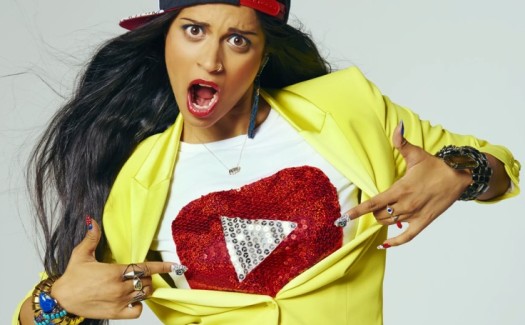
Lilly Singh, or as she calls herself – “||Superwoman||” is an Indian-Canadian YouTube personality. She has 8 million subscribers on YouTube. She started her channel in 2010 because she became aware that as a woman of Indian descent, she wasn’t really seeing her story represented in the media. She said she couldn’t see “people like her” on the internet. She also used her vlogging and her YouTube channel to deal with her depression. It’s often said that comedians use their comedy to vent their frustrations; Lilly Singh did the same. Her comedy sketches cover various topics, but they are definitely influenced by her Indian heritage, especially the many videos about her parents. Some of her most popular videos are “How Girls Get Ready”, “Girls On Their Periods”, and the series: “My Parents Reacting to.” ||Superwoman|| was ranked at #39 on New Media Rockstars Top 100 Channels in 2014.

Lilly has also collaborated on different channels. In 2013, Lilly partnered with the channel ILoveMakeup to act in the shows on the channel. Lilly’s show “Giving Black Glam” on ILoveMakeup sought out women with stories, and gave them makeovers. Lilly has also starred on the web series “The Tube Hautest” where she played four different characters in a mock Project Runway type show. Lilly also started a fictional show on YouTube “Lana Steele: Makeup Spy” where the main character who is a spy (Lilly) uses makeup to disguise herself. The show had twelve episodes and is currently being considered for a second season.

In 2016, Lilly announced a world tour called a “Trip to Unicorn Island.” Her tour covered India, Australia, Hong Kong, Singapore, UK, Dubai, Canada, Trinidad and Tobago and the United States. She documented the tour in her first movie, A Trip to Unicorn Island, which also shows how the YouTube fame is affecting her life. On her website, “Unicorn Island”, she sells clothes based on her YouTube character. In August 2013, Singh featured in Jassi Sandhu’s song “Hipshaker”. In March 2014, Singh performed a rap for the song “Mauj Ki Malharein”, used in in the Bollywood movie gulaab Gabg.

In September 2015, People included Lilly on their “Ones to Watch” list. In October 2015, she ranked 8th on Forbes’ list of World’s Top Earning YouTube Stars of 2015. In December 2015, Singh moved from Toronto to Los Angeles, California. She appeared on the The Tonight Show with Jimmy Fallon on January 22, 2016. She also appeared on The Daily Show with Trevor Noah on February 4, and The Today Show on February 5, 2016.
||Superwoman|| is successful because Lilly managed to find a niche and meet an unmet demand. Like she said, she wasn’t really seeing herself represented on the internet. Indians make for 1/6th of the world’s population and no other YouTube celebrity was really targeting them before Lilly. Another reason why her videos work is because she’s exceptionally good at skits and her impersonations of her parents are hilarious. She also is very regular. She posts every Tuesday and Friday, without fail, which her fans appreciate.

Review: Here to Make Friends

Publisher’s Weekly Starred Review

Here to Make Friends is a podcast by Huffington Post hosted by Executive Women’s Editor, Emma Gray, and culture writer, Claire Fallon, both of whom work for The Huffington Post. In each episode of Here To Make Friends, Emma and Claire recap an episode of The Bachelor, and are usually joined by a special guest. These special guests are either old Bachelor contestants like Andi Dorfman (Bachelorette Season 6) or fellow Bachelorette bloggers, like the Bachelor Dudes. The Bachelor series has always been controversial because of the way the show treats its contestants, especially women. It has also received ridicule for the insensitive ways it does, or more accurately, does not, deal with issues like race and sexuality. Frequently, the villain of the show—usually a woman who is empowered or confident in her sexuality—is bullied online by what is arguably the core audience of the show: conservative, white, middle-America.

In the podcast, Emma and Claire talk about all of these topics and use parts of their podcasts, like the “Feminism Fails!” section at the end, to really dissect these issues and more broadly connect these incidents to similar structures in the real world. I watch The Bachelor and The Bachelorette primarily because it does not try to be politically correct and perhaps inadvertently sets itself up to honestly portray some of the social constructs in society. Many questions come up over and over again are—is the black person on the show just a token contestant? Why can the Bachelor have sex with multiple women, but when the Bachelorette does the same, she is slut-shamed? If you’re a woman on the show and not white, tall, thin, and happy, will you be ostracized? (Probably yes.)

Claire and Emma do a great job really getting into these issues. More importantly, they are able to appeal to a growing audience of The Bachelor watchers like myself who don’t really approve of everything that goes on in The Bachelor franchise, but are able to relate to some of the experiences of the people on the show and connect them to real life. As we watch The Bachelor, we want to discuss these issues in detail and that’s where this podcast succeeds. Emma and Claire unpack each episode with intelligence, humor, and some much-needed snark. I highly recommend it to all of The Bachelor viewers!

NPR Audio Review

[soundcloud url=”https://api.soundcloud.com/tracks/248786952″ params=”color=ff5500&auto_play=false&hide_related=false&show_comments=true&show_user=true&show_reposts=false” width=”100%” height=”166″ iframe=”true” /]

Tweet Review

If you hate to love #TheBachelor and want to work out that Bachelor angst @Huffpost’s smart and snarky podcast #HereToMakeFriends is for you

The Future of Podcasting

1. Where Are We Now?: The Podcast Celebrity Moment

Podcasts are currently having a celebrity moment. The hype and frenzy was brought on by the viral true crime podcast, Serial. Everyone was talking about the podcast, actively engaging with the content on forums, and eagerly waiting for every episode to come out. Usually podcast celebrities, much like radio celebrities, are rarely important enough to be on television, but Sarah Koenig, host of Serial, created enough hype with the general public to be brought on to The Colbert Report. Other celebrities are also podcasting, including Alec Baldwin, with his celebrity interview show Here’s The Thing, John Oliver with The Last Week Tonight and The Bugle, Ricky Gervais with The Ricky Gervais Show, and Cheryl Strayed with Dear Sugar Radio.

2. Growth of Podcasts

Podcasts, only recently prominent in pop culture, have been around for a while. While New York Magazine declared there was a “great Podcast Renaissance” in October 2014, the truth is, podcasts have been steadily growing every year. It’s true podcasts weren’t being talked about much from 2008–2013, but according to Jordan Harbinger, host of the popular podcast The Art of Charm since 2007, it’s because, “it wasn’t new anymore, so nobody was talking about it. But if you look at the statistics…podcasting has been growing steadily, in great numbers.” Indeed, Rob Walch of the podcast hosting service Libsyn agrees, noting that “smartphones, and specifically the iPhone, have really been the driver of growth the last few years” because they make podcast downloading and consumption easier.

3. The Final Frontier: Podcasts in your Car

According to a report by GSMA, by 2015, 50 percent of new cars worldwide will come equipped with internet connection. By 2025, it’ll be a 100 percent. “When that happens and there are podcasts in everybody’s car, it’s not podcasts anymore,” says Harbinger, “it’s just the radio.” This is bound to grow the podcast industry dramatically, as people without smartphones or who don’t really know how to access podcasts through an app on their phone will have easier and direct access.

4. Everyone will Podcast

Podcasts are about to become hugely popular to listen to and to make. With podcasts in cars and easily accessible to everyone, competition is only going to go up. Podcasts is becoming a viable medium, and corporations are going to get in and produce great shows to sell their brand and content. Therefore, this is the time to get in, and create a following for your podcast.

5. Monetization beyond Ads

Podcasts currently make their money through ads, and this is a good revenue system. However, in the future, the ubiquitous nature of podcasts will allow people to make brands and sell their services beyond just their podcast. For example, Jordan Harbinger from The Art of Charm piloted a self-help program at $50/hour. They’ve now expanded their services: “We started to hire consultants and therapists so we could get our curriculum to be really good, and we started to monetize and now have workshops.”

6. Podcasting is like Blogging

According to a Neiman report, podcasting is following much of the trends of blogging back in 2004. As the article states, “The question now is whether podcasting’s future will play out as the last decade of blogging has.” That is, outlets like Buzzfeed and Huffington Post thrived, unlike more independent smaller bloggers. Traditional media like print (and in the case of podcast, radio) suffered. However, this also ensured improvement in the quality of content. As the Neiman report states, “Podcasting will endure a similar evolution, with so much adaption that “podcasting” will erode as a term while the form becomes ubiquitous.”

7. An On-Demand Talk Radio

As we’ve seen with Netflix and iTunes, consumer behavior has changed suggesting that consumers want to consume content unbundled and at their own pace. Just as catering to this behavior changed the television, movie, and music experience, this is poised to change the radio industry and bring a rise in the use of podcasts. Terrestrial and satellite radio currently occupies 74 percent of all audio consumption, while podcasts only cater to 2 percent of the audience. However, with better quality, better technology, better content, and better revenue, podcasts are poised to take over traditional talk radio.

8. The Rise of the Networks

When YouTube first started, a small number of independent YouTube-ers would put up videos, but in 2009, big networks like MakersStudio and FullScreen started producing and releasing videos in high quality. This is already starting to happen with Podcasts. PodcastOne aggregates all the best podcasts, 5by5 is a podcast space for all things “geeky”, and EarWolf produces comedy podcasts.

9. A New Creative Space

Serial, Welcome to Night Vale, and This American Life have shown us that podcasts can be a really creative space if utilized intelligently. While the majority of the podcasts follow a talk radio type of model, the last few years have shown that stories, both real and fictional, can be told through a podcast. Therefore, in the future, more experimentation with the trend, and with more creative content is predicted.

10. Rise in Smart Podcasting

Jeremy Finch in his article, The Future of Podcasts asks really interesting questions about the technology that comes with the medium of podcasts: “Can podcasts be richer and more multidimensional than they are today? Could we redesign tomorrow’s podcasts so they adapt to where we’re listening and what we’re doing at that moment? Can we transform a historically static listening experience into a more responsive and dynamic one? If podcasting is the natural evolution of terrestrial radio, what will be the future of podcasts?”

Groupon founder, Andrew Mason, is attempting once such technological advancement, Detour, which uses phone GPS to geo-tag audio files to actual places. Therefore, the museum audio guide listening experience can be brought to actual neighborhoods you’re currently in. As Finch says in his article, “Imagine, for example, walking through Fisherman’s Wharf as you listen to interviews with actual fisherman from the docks, or wandering around Walden Pond as you listen to transcendentalist poems and stories about Thoreau.” This blending of digital and physical experiences is called integral reality. Many such advancements can be predicted for the future of podcasts.

An Ode to Code

As Told in GIF Form

Before this class, every time I thought about coding HTML and CSS, I was quite terrified.

via GIPHY

I was sure it the class was going to be difficult, and that the learning to code HTML/CSS would be the hardest part.

via GIPHY

And I was relatively right.

via GIPHY

When I first started to write the code for my website, I was completely lost.

via GIPHY

I was on hundreds on forums looking for the answer to the simplest of things.

via GIPHY

Like, how to draw a small vertical line across the screen.

via GIPHY

It took combing through multiple forums and deciphering coder-speak to really find the answer to my problem.

via GIPHY

But every time I did, it was the best feeling.

via GIPHY

I would write the code and then watch it work, feeling very powerful.

via GIPHY

Even though it was just because I drew a line.

via GIPHY

Now that I have conquered HTML.

via GIPHY

Or more like, poked it with a stick.

via GIPHY

I have turned my attention to CSS, which has me flashing back to that helpless feeling.

via GIPHY

While HTML was a challenge, CSS is proving to be way more difficult.

via GIPHY

But I’m sure if I spend enough time experimenting,

via GIPHY

And enough time begging other coders for an answer,

via GIPHY

I will again have my AHA! Moment.

via GIPHY

Well. Here’s hoping.

via GIPHY

Experiments with HTML and CSS

When I first designed the wireframe for my website, I was quite ambitious with how I wanted it to look. Ideally, I wanted my homepage to be divided into two columns. A large column on the left of the screen would act as the “About” section for my website. In a slimmer right side column, I wanted to organize my social media links to allow users to connect with me through different platforms such as Facebook, LinkedIn, and Twitter, and view my ongoing Twitter feed.

I ran into some problems with coding a vertical line separating the two columns and then subsequently aligning the text “Let’s Connect!” to render flush left against the horizontal line on the right side of the screen.

Creating Vertical Lines

I was able to make a vertical line, thanks to a CSS How-To on Houston Chronicle. Through this guide, I learned I had to specify the margin and the height of the line. That line of code eventually looked like this:


<div style="border-right:medium #000000 solid; position:absolute; right:350px; height:800px;" />

Aligning Text

To align the text flush-left against the vertical line was a more difficult task. With the help of a forum question at Stack Overflow, I learned I had to define the position of the text so that it was relative or absolute, and then experiment with the px to move it across the screen until it aligned correctly. The final code looked like this:


<h2 style= "position:absolute; right: -200px;"> Let's connect! </h2>

Both the line and the text eventually looked like this when I ran the code:

Snapshot of Shiva's website wireframe
My website wireframe.

If you too need to create a line or move text across the screen using code, I hope this guide comes in handy!

The Hindu: Then and Now

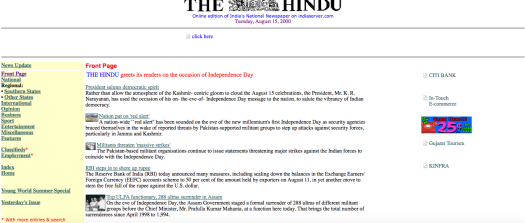
Growing up, The Hindu, a leading Indian daily, was the one newspaper my family and I read every day. Therefore, it is interesting to see how their website has grown over the years. The Hindu had a surprisingly early web presence. The first instance of their live website was on December 12th, 1998. The website was quite basic, with the news being divided under sections such as “Front Page,” “International,” “Business,” and “Sports,” much like how one would see it in a print newspaper. Clicking on “Front Page,” would list all the articles that appeared on the front of page of that day’s newspaper and allow you to click through each article. The font was a dated serif font. At this stage, there didn’t seem to be many ads, but there are a few of supplementary magazines for The Hindu listed on the side of the website.

As early as August 2000, The Hindu introduced ads on their website, with flashing images lining the side (Call India 25 cents/m!). Each article also had a link at the bottom which read “Send this article to Friends by E-Mail” and looks like a throwback to what is now the popular “Share” button on all online publications. The homepage looked a lot cleaner, and the title appeared in a bright red and blue font. The mobile design was the same as the website design at this stage.

Looking at their website now, there are many improvements. The website allows the reader to access the news in two different ways. The reader has the option of reading the digital publication in the same way they would read the physical newspaper via the “Today’s paper” link. Through this method, you can read the newspaper articles in order and bundled as in the physical paper. The other option is to read the paper by jumping through different sections via the drop down menus. The drop down menus are quite specialized, allowing you to find cricket news, for example, not just under “Sports,” but also directly under “Cricket” or “Hockey.”

I also like that the homepage isn’t littered with many photos. There are a couple, but they aren’t overwhelming. Instead, they provide context to the top story of the day and direct the reader’s attention there. The logo is clean, as is the easily clickable Facebook, Twitter, and Instagram widget which connects the publication to different social media platforms. There are no ads on the current website.

The Hindu is considered to be a serious publication, and therefore uses simple colors on the website—white and grey, and a stark blue logo—which make it look clean and elegant. This image fits with the brand of The Hindu. The website loads in less than a second, perhaps due to the lack of videos and images on their website. There is also a comment section at the end of each article, but this seems to be rarely used. On the other hand, the Facebook and Twitter share buttons show numerous likes and shares, so the community therefore seems to be active on these social media platforms.

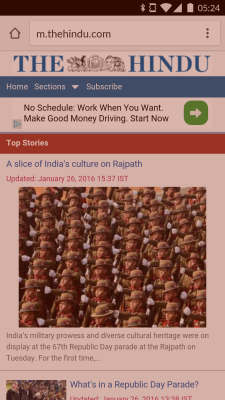
The mobile website does seem to have a longer load time of about 3–4 seconds, and it loses some of its desktop features. For example, there is no daily newspaper; instead it is divided by subject matter. The m.hindu.com website also seems to have an ad banner which is missing from the full website. Overall, the mobile design is a little more clunky than the website design. I think it would be helpful to have a sidebar that pops in and out and divides the paper instead of users having to scroll through sections such as “Breaking News,” “Editorial,” and “Magazine.” Despite what it lacks, it serves well as a companion to the full website. But if readers are looking for a cleaner and more streamlined experience, The Hindu is best viewed in its desktop version.

The Hindu mobile version

An Introduction to Shivangi

About Shivangi

Whenever I’m asked to describe myself, the first thing I say is I’m a musician. This is partly because music is the first thing I remember being interested in, but also, my passion for music has followed me my entire life. From performing Indian Classical Carnatic music in Hindu temples as a kid, to playing drums in an all-girl metal band as a teenager, to busking as a musician on the streets of New York and New Delhi, music has been my one constant. I’ve been able to give my interest in music so much space to grow because I make an effort to travel as much possible. Most recently, I backpacked through Portugal and Spain this past summer. I’ve also lived for prolonged periods in two countries, India and the United States, and therefore accumulated lots of strange experiences and a number of weird jobs. I host a popular Bollywood podcast in the United States, I’ve edited the Oxford Dictionary in India, and I currently edit subtitles for Netflix. At first glance, it may seem like my interests and experiences are varied and unrelated to each other, but when I pursue opportunities and seek experiences, it always comes down to finding ways to be creative, think on my feet, and let every opportunity take me as far as it possibly can. Therefore, I am certain that I will rock at Emerson!

What Shivangi Hopes to Learn

As an editor that has primarily worked with print content, I would like to learn how to speak the programming language. I want to be able to think about content in a digital space – that is, how does one take content originally in print and format it to be user friendly in a digital medium? I hope to delve into the financial aspect of electronic publishing, specifically focusing on how to make digital products profitable in a market saturated with free content. I am also curious about the history of electronic publishing. I would like to further study the growth of this space and hopefully use that data to better predict future trends. I hope to experiment more with different digital formats such as podcasts, blogs, and YouTube, and be comfortable using each of them. I want to learn how to write for Twitter and other such social media platforms, where it is necessary to write in a short, engaging way. Overall, through the course of this class, I hope to expand my knowledge of electronic publishing and to start engaging more frequently with its many components.