A Bookstore Giant Trying to Make a Profit in the eBook Market

Several years ago, I bought my first e-reader to supplement my growing library of print books. That e-reader was the Nook 3g, and I loved it for the years it accompanied me. It had a tiny color touchscreen at the bottom, an e-ink display for reading at the top, and free, built in 3g internet. Before I upgraded to the Nook HD+ I could not imagine separating myself from my first Nook, and I have always preferred my Nook over the Kindle some of my friends had because they started reading ebooks before the Nook came about. But while there are people like me who are die-hard Nook users, the Nook is no longer a part of Barnes &Noble’s success story.
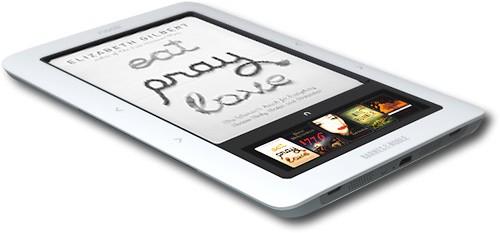
This was one of the earliest Nook devices coming out more than two years after Amazon launched the Kindle.

Barnes & Noble was first founded in 1873 and it continued to expand throughout the 1900s to become a major player in the bookselling industry. The company now has over 600 brick and mortar stores throughout the United States, and has expanded their retail business to include specialty items such as games, toys, and music. These non-book items offer higher profit margins for booksellers so they can keep selling books, but with the dawn of the digital age in books and competition from Amazon, Barnes & Noble had to step into a previously uncharted area in 2009 or risk losing a customer base that was doing more and more of its book buying online. That year, the Nook e-reader was launched, and it managed to sell millions of devices in its first few years.

Three generations of the Nook, its transformation into a tablet, and several apps and updates later, Barnes & Noble found it was no longer financially feasible to try to compete in the tablet/e-reader market. In 2013, Barnes & Noble sold their remaining Nook devices at discounted prices and announced they would no longer be making their own tablets. If you buy a Nook tablet now, you are actually buying a Samsung tablet that features the Nook and the Nook store among its applications. Yet Barnes & Noble has not given up on e-readers entirely.

Nook partnered with Samsung and now provides three different Samsung/Nook tablet options.

The company is still making the simpler black and white version of the Nook. In its latest rendition, this e-reader is called the Nook GlowLight Plus. It’s geared towards serious readers who want to get as close as possible to the print reading experience. The device has a 300-dpi screen, a battery that lasts up to six weeks, and an illuminated screen for reading in bed or outside, and it’s even dust proof and waterproof so people can read anywhere, anytime.
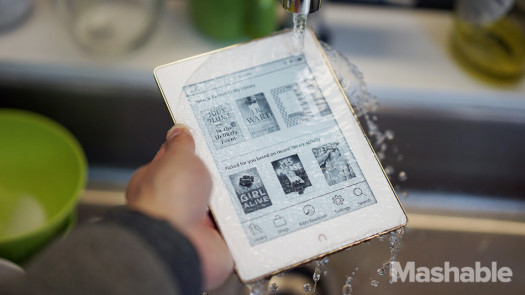
Mashable shows the Nook is in fact waterproof by running a simple test.

Although Barnes & Noble cannot compete with Amazon on the same level, the bookseller continues to utilize their Nook as a way to sell and profit from digital content and hopefully attract customers to their brick and mortar stores nationwide. With their ventures into illustrated and out-of-print book publishing and their inclusion of independent titles in their Nook shop, Barnes & Noble hopes to be more than just a place to buy the latest bestseller or browse the bookshelves for books to buy from Amazon later.

Arige Is “Going Off Book” – Interview

Pubcast student Arige spoke about her love for books and TV for her upcoming podcast, Going Off Book.

How did you come to choose this topic for your podcast?

I was trying to think of something I could see myself talking about for more than a few minutes and realized I could combine two of my favorite things, books and TV shows, into one podcast. I watch so many shows at are based on comics or books that it seemed like a great place to start.

What makes your podcast different than others already out on the web?

I love books and I religiously record my favorite shows, so my enthusiasm for the topic sets my podcast apart.

What do you think will be the hardest and easiest parts of the podcast?

The most difficult part will be stopping myself from rambling on in total fangirl mode. I don’t want to talk too much about specific events in the books or shows (because, seriously, SPOILER ALERT) but I still want my listeners to understand why I like them.

The easiest part will be finding books and shows to talk about since there are so many to choose from.

What excites you the most about this podcast?

I love getting the chance to see books I have read come to life outside of my own mind. Sometimes a movie-length adaptation isn’t enough to bring an entire world to life, so TV shows give the books a better chance at being fully realized. Really, I’ll take any excuse to talk about my favorite books and TV shows, and I hope that in doing some research on this topic I’ll discover new favorites.

Do you see a long-term future for this podcast?

For the first few episodes, I would focus on books I’ve read and the shows that they are based on, but there are a ton of shows based on books I have not had a chance to read yet. For example, I watch The Shannara Chronicles and Pretty Little Liars but have not read the books they are based on. There are so many to choose from and new shows start every season, so there is definite long-term potential. I’m just not sure that long-term podcasting is in the works for me, what with all the shows I watch and books I read that demand my free time!

If you had to do another topic for a podcast, what would it be on?

Another podcast idea I had was a podcast about the oral tradition of storytelling. I thought it would be cool to explore the role stories such as folktales have played in things like education and entertainment. I grew up in a community that really valued oral storytelling as part of its culture, and these stories were used not only to teach morals and life lessons, but also to teach history.

Through the Times

During my first semester at Emerson, I was required to read The New York Times on a daily basis. After weeks of waiting in vain for home delivery, I began relying on the online publication. With it, I could get the same content and not worry about ink covered fingers. I no longer look for a printed version of the paper since the website is easily accessible. But has it always been user friendly?

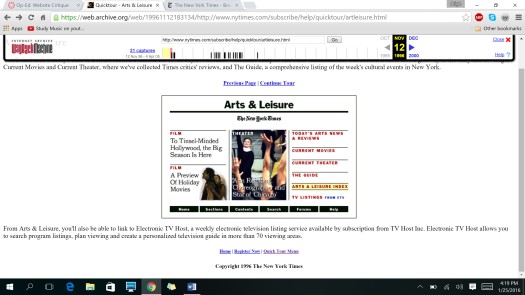
Archive.org capture of http://www.nytimes.com from 12 November 1996

The New York Times had its first web presence on November 12, 1996. The site allowed visitors to take a guided tour of how the content was managed after free registration. Twenty years later, the website’s purpose—to make the news more readily available—does not seem to have changed, but the site’s overall appearance has.

Archive.org screenshot of "Arts & Leisure" section from 12 November 1996
Archive.org screenshot of “Arts & Leisure” section from 12 November 1996

In the original design, the few examples of graphics and multimedia were much smaller and simpler than those found today, and the color scheme was basic red and black. Many of the pages functioned mainly as a table of contents, with little more than a title provided to link to the article. On the main page, the original design included the logo and the phrase “On the Web.” The search button was also buried within a clunky links bar at the bottom of the page. When I looked at the original site from my phone, I had to zoom in because it was essentially a miniature version of the web view that was difficult to read from a mobile device.

Screenshot of the nytimes.com from 25 January 2016
The nytimes.com from 25 January 2016

With its modern incarnation, The New York Times has created an online viewing experience that rivals their print version. The headlines and the short blurbs about each article are easily visible once you log in. The site even provides the option of viewing the print version of the paper in an online format they pitch as “The daily newspaper, reimagined for the web.”
The presence of widgets and multimedia components is impressive as well. Articles include relevant photos and videos with readily available links to share them across platforms. There are several menu bars and link bars that can be accessed from different places on a page, which is useful since pages can be long. Despite the large amount of content on each page, the site and its components load quickly and are accessible on mobile devices. Even comments are incorporated seamlessly into the posts; viewers can choose to ignore them where they linger on the right side of the page or they can click on them and have them pop out on a separate screen. I may not comment, but I like that I can read other people’s comments so easily.

View of nytimes.com news article

I’m not the kind of person who enjoys reading the news on a regular basis, so I like that this publication includes the leads from each article in the main pages. It allows me to be choosy about what I read and to skip ahead to what I actually want to read about: books. In terms of design and accessibility, The New York Times has managed to upgrade to a good website. Now if only they would recreate the sticky links bar for the mobile version so I no longer have to scroll endlessly on my phone, I would say they have a winner on their hands!

Meet Arige

Headshot photo of Arige Shrouf

Although I was not born in the United States, I was raised in the Virgin Islands, which is a US territory. I’m also multi-racial—my dad is Arab and my mom is half-Dominican, half-Puerto Rican. Coming from a diverse background has given me the opportunity to learn three languages, even though my fluency differs among them. This is my first time living within the 50 states, and since we drive on the left in the Virgin Islands, I have never driven on the right side of the road. That’s a convoluted mess I expect I’ll have to tackle one day, so it’s a good thing having a pet chick when I was little improved my sense of humor. Imagine having to chase a chick to keep it from eating your chicken off your plate! Once you get over the horror of it all, it’s rather funny. And that’s why I’m going to rock at Emerson!

But before I can say I’ve rocked Emerson, I have to rock this semester in Electronic Publishing, and I expect to learn a huge amount of new material. In the past, I have not had the best of luck with technology and software seems to hate me, so I would mainly like to learn how to make them work in my favor. The first logical step would be becoming proficient with the software I need. I would like to learn more about building a website and customizing it and I am curious about how paywalls work. I have somehow managed to avoid social media outside of a few minutes of Facebook browsing a day, so I am also interested in learning about which social media sites are crucial to my survival in the publishing world. I have absolutely no experience with podcasts, so I would like to learn how they work and how they are generally used. I’ve really just hit a few of the highlights of what I would like to learn and there is so much more I probably don’t even realize I should be thinking about, but I’m excited to take on this class and this program at Emerson.