Amazon and the eBook

Amazon’s place in the market is incomparable, and the same can be said for their influence in the e-book industry. From the Kindle’s introduction to the public in 2007, the e-reader continues to be wildly successful. Much of its success can be attributed to the technology itself, offering e-ink screens with high readability, as well as the devices’ competitive price-points. The Kindle has gone through many iterations including seven generations with their own variants and most recently, Amazon has introduced several versions of the Kindle Fire, a device that utilizes a full-color touch screen and also supports multi-media such as movies, music, and the ability to download apps.

Originally, the Kindle was only available to US users but has since expanded to over 100 countries after its international launch in 2010. By far, it is users who have benefited most from the Kindle, whereas its effect on publishers and authors has been more mixed. In an effort to get as wide a distribution of the device as possible, Amazon has routinely sold devices at cost, as was the case for the Fire HD. This also allowed Amazon to sell devices at ultra-competitive pricing. The Kindle also offers users several features and a Kindle app that allows users access to their libraries on several devices including PC, Mac, Android, and iPhone, and ultimately merged with Samsung’s e-readers. Other features include multiple device downloads for titles, user-created annotations, and textbook rentals for students.

They have, however, failed users in notable ways and incited controversy in 2009 by withdrawing Animal Farm and Nineteen Eighty-Four by George Orwell after discovering the publisher did not have the rights to the titles. Amazon remotely deleted the content angering users who had left annotated notes they could no longer access, and, in one particular instance, lead to a lawsuit with a high school student in which Amazon was forced to remit $150,000 in a settlement.

Publishers, Hachette in particular, have also come to blows against Amazon in response to the severely-discounted prices at which they have sold e-book versions of their titles. Publishers were finding it incredibly difficult to compete and felt the company was directly hindering their ability to sell print versions, especially hardcovers when Amazon was offering a digital version for $9.99. This lead to many publishers making agreements with Apple and resulted in a lawsuit over collusion and price fixing that ultimately found in favor of Amazon. In this instance, the publishers’ loss is the consumers gain, as they continued to be able to purchase e-books at low rates.

For authors, Amazon has been both helpful and harmful. It has allowed self-publishers access to niche audiences and millions of users, as well as a platform to distribute their work which would otherwise be passed over by major publishers. Instead, it allows authors direct access to countless potential readers. For others, however, the low pricing has proved detrimental to author’s royalty rates. In terms of publishing, it is relatively simple for independent authors to publish using Kindle Direct Publishing. However, Kindle uses its own proprietary format (AZW/KF8) and does not support epub, meaning authors who choose to publish their books through Kindle only have their books accessible to Kindle users.

Despite their controversies, Amazon continues to dominate the market and remains extremely successful. They reported 5 billion in sales in 2014 alone. In order to maintain their hold on the market, Amazon will need to continue releasing devices at affordable rates, which already appears to be their goal. The Fire 7 was released in September of 2015 at $49.99 making it the lowest priced tablet released to date. Coupled with the competitively low price of e-books and over 300 million active Amazon accounts, it is likely Amazon will continue to dominate in the e-book space.

Book Trailer Pitch: Cosmicomics

Few books have left as much of an impression on me as Calvino’s Cosmicomics. The stories have inspired both my own writing as well as multiple pieces of art. Because of the metaphysical quality of the work, I imagine a trailer that would capture the same abstract feeling of the stories which make up for the intangible subject matter by supplying a wealth of beautiful and profound notions about life, love, and longing in an otherwise impersonal universe.

[Script]

Cosmicomics, by Italo Calvino, is a whimsical collection of short stories with many unexpected characters. The twelve stories were originally published in Italian in 1965 and are each based off a different scientific concept such as the big bang, the expansion of the universe, evolution, and various other theories about existence. Rather than relaying these stories as if by a human character, Calvino anthropomorphizes ethereal entities that sometimes exist outside of time itself. The imaginative stories give colorful explanations of life before the universe and are told as wistful memories of the nebulous narrator.

Because of the surreal nature of the stories, I think the best form of representation for this book would be illustrative. The characters exist beyond the realm of what’s real, and the only way this can be portrayed in a way that’s analogous to Calvino’s metaphysical descriptions would be through some kind of animation. Each story is relatively short, and could serve as a trailer in its own right. In fact, there have been many animated iterations of his most famous story, “The Distance of the Moon,” that play upon the amorphous quality of the cosmological beings involved. But instead of focusing on a single story, I think several small scenes or snapshots representative of the twelve stories which sort of blend into each other would provide a more complete feel of the themes involved in the book as a whole as well as keep from giving away the entirety of any one story, which should be discovered by the reader. All of these would be accompanied by some kind of celestial music to match the tone.

In terms of aesthetics, these animations would be painterly in quality, and morph into each other much in the way the characters in the stories lack the hard edges and concrete descriptions you’d normally find in books. As a whole, the trailer will represent Cosmicomics in both concept and tone, allowing for as clear a vision of the book a reader can hope for without actually reading it, and which will hopefully encourage them to do so.

[/Script]

As the pitch describes, the subjects of the stories are difficult to represent using anything that exists in the real world. The characters exist beyond what is real and exist solely in the reader’s imagination. Therefore, relying on artistic representations would best reflect the nature of the book in a way that is both truer to form and visually interesting. Such a trailer would undoubtedly pique the curiosity of viewers and inspire them to give the book a read.

Why PewdiePie?

It’s hard to fathom PewDiePie’s (real name, Felix Arvid Ulf Kjellberg) astronomical rise to YouTube stardom. The Swedish-born 26-year-old began his YouTube career in 2011 after dropping out of Chalmers University of Technology where he was studying Industrial Economics and Technology Management in order to focus on his videos. His earliest videos consisted of video game walkthroughs with audio commentary of his thoughts and reactions. Later videos utilized a small screen view of the gamer and his commentary in the style of Twitch allowing the viewer to see the physical reactions, which in PewDiePie’s case, tend to be drastic.
Unlike other walkthroughs meant to serve as guides, PewDiePie created more reaction-based content full of random outbursts and profanity. His earliest videos tended to be of the horror genre, involving games such as Amnesia: The Dark Descent which relied on jump-scares and generated wild outbursts from PewDiePie. Viewers responded well to the casual tone and humor of his videos and he began to amass subscribers to his channel. He is also credited as being one of the first to capitalize on the video gamer audience to gain a substantial following. Finding this underserved niche on YouTube at the time played an important role in his future success.
The content of his channel is goofy, full of energy, and often obnoxious (especially in regards to the high-pitched and stretched out manner he introduces himself). But it succeeds in its off-the-cuff casual tone and the sense of connection he is able to make with viewers due to the channel’s informality. Today, he has hundreds of videos with varying content and much better production quality due to his exponential rise in popularity. These contain animated shorts, personal vlogs, collaborations with his girlfriend and fellow YouTuber Marzia Bisognin CutiePieMarzia, and sponsored content. In fact, his popularity is so widespread that he has created several reaction videos to the hate he receives through comments and parody videos of him.
PewDiePie has an incredibly impressive history in terms of YouTube subscribers. In 2013, he surpassed six million subscribers and garnered coverage on The New York Times. In July of that year, he surpassed fellow YouTuber Jenna Marbles with 10 million subscribers, then the channel Smosh in August with 15 million subscribers making his the most subscribed channel on YouTube. Now, in 2016, PewDiePie’s channel has amassed almost 43 million subscribers.
His popularity has extended beyond YouTube with several pop culture references. Most notably, he parodied himself in a two-part episode of South Park titled “#REHASH.” He is also credited as having influence over the game world with many of the indie titles he showcases reporting boasts in sales due to his video promotions. Recently, he has starred in a YouTubeRed exclusive web series called Scare PewDiePie which capitalizes on the popularity of his early horror game commentary and wild reactions that first gained him popularity.
It is difficult to pinpoint what aspects of his videos have made him so successful. To many viewers (myself included) his videos seem obnoxious, self-serving, and in general, pointless. But the massive amount of subscribers, billions of views, and reported 7.4 million earnings for 2015 contests that his videos are definitely doing something right. One important aspect of his success is content. He has been able to capitalize on the popularity of video games as it ties to a culture largely based on the internet. He has also managed to seem genuine in both his reactions and intentions. People have responded well to his unfiltered and profanity-filled commentary, crude jokes, and jarring outbursts as it seems real and unscripted. And perhaps most importantly, he has been able to foster a sense of community by actively engaging with his audience through comments, forums, and in public events. These aspects have added up to PewDiePie’s immeasurable success.

The Fangirl Phenomenon: A Q&A with Tarsilla Moura

We sat down over burgers and fries with Tarsilla Moura to discuss her podcast which explores what it means to be a “fangirl.” As a self-proclaimed fangirl, Tarsilla had many insights into what some consider an extreme obsession. Through her podcast, she hopes to gain perspective on why particular genres of media generate such strong responses from fans, and shed light on the issue for those who may be unfamiliar with the term, or who are curious as to what it means to be a part of a fandom.

Jess: So, tell us about your podcast.

Tarsilla: So my podcast is going to be about fandoms and the community of fans and how they get so obsessed over shows, and movies, and music, and artists, and real-life people, and I just want to explore the culture, the why behind that, and basically retell examples of it, because their interaction on social media is so funny and I think other people are going to find it funny too.

Shiva: Is there an experience that helped you come up with this idea?

Tarsilla: Just me being one of these people pretty much, and just trying to understand why I’m that way. And realizing other people are that way too.

Jess: Can you give an example of what particular show, or music that you would consider yourself a fangirl of?

Tarsilla: Yeah, Glee. Glee was one of those.

Jess: Glee?

Shiva: Glee! I love Glee.

Jess: I’ve never actually seen it.

Tarsilla: That fact that you love Glee, shows that you’re not a fan, because the true fans hate Glee.

Tarsilla, Shiva: [hahaha].

Jess: What? How are you a fan and you hate it?

Tarsilla: Well because you get so invested in it that you find out every little thing in the show. You start following the director, and the creator and the writers, and you’re just like, “no, I want my characters to do this,” and the writers do something different and people just get so angry. It’s like why are you mistreating my favorite character? I want my character to be in a relationship with this other character! It’s crazy and you end up hating the show. That’s what fangirling does. You love it so much that when it veers off course from the plan for the future you have for it, you just end up hating it, and hating everything, and sending hate to people.

Jess: Have you actively tweeted creators?

Tarsilla: Yeah. Oh yeah. I had to delete my twitter and come up with a new one because I was tweeting so much hate to Ryan Murphy.

Jess: Haha, oh my gosh.

Tarsilla: Yeah he blocked me a couple times. I’m not proud of that, haha.

Jess: So, why should people tune in to your podcast?

Tarsilla: I guess there’s two sides of it. I think for a lot of people, it would be interesting to hear things that relate to them. And maybe it would help people not to take it so seriously, and maybe laugh a little bit at themselves so they can maybe just understand that even though it feels really important and it starts consuming your life, it’s really not a big deal. It is just a show, and just like, chill. And then other people that maybe see the other side of it and just think it’s ridiculous, maybe they can understand a bit more and not make so much fun of people that do end up getting that way. It’s hard, I know it’s really funny, but people get that way for a reason. They honestly just do care too much.

Shiva: Are you part of a group, or like a fan club or something? Is there other people that you talk to about fandoms?

Tarsilla: Oh yeah. There are forums online, for sure. When you find those, it’s like the opposite of AA, people encouraging you to do this.

Jess: Is there any other shows you are part of the fandom of?

Tarsilla: Right now, probably The 100.

Shiva: The 100?

Tarsilla: Yeah, that’s the one I’m super invested in.

Shiva: What is that? I haven’t seen it.

Jess: Yeah, what is that?

Tarsilla: It’s on the CW and the first two seasons are on Netflix. So you know how you mentioned Game of Thrones Earlier? It’s been connected to Game of Thrones a lot because it’s that style and it’s a lot about wars, and it’s set in a futuristic world. [In the show] a nuclear bomb went off and the survivors went to space, and then one hundred years later they come back down and they find that people survived on the ground. One of the episodes this season was called, literally, “Watch the Thrones.” It’s a cool show. There’s a reason why people get so obsessed with it.

Shiva: Actually, I just heard people talking about this show

Jess: Oh really? I’ve never even heard of it.

Jess: Were you inspired by any podcasts, or have you heard of any podcasts like this one? Or is this just something you came up with?

Tarsilla: It’s probably something I came up with. Because I hear, for instance for The 100, there’s a podcast with two ladies reviewing the episodes, and they are hilarious to listen to, and they go through everything. And they also talk about the fans and how they get a little too obsessed with it. So maybe from hearing them, I got this idea in my head. But I don’t think there are any other [podcasts] out there that talk about this specifically, like focused on the obsession of it. So I guess that is what sets this show apart.

Jess: Awesome, thanks!

So, if you’re a fangirl yourself, or just curious about the culture, be sure to check out Tarsilla’s new podcast for an in-depth look at fandoms and their prevalence in response to today’s multifaceted and obsession-inducing media.

Podcasting Then and Now

1. RSS Enclosures

Podcasting originated in 2000. Tristan Louis, an XML developer, suggested an enclosure to the 0.92 version of RSS. Former MTV VJ and well-known podcaster, Adam Curry, had also been thinking about how to deliver audio and video media to people through broadband around the same time.

2. Grateful Dead

Adam Curry pitched his idea of adding audio and video elements to Dave Winer, the developer of RSS 0.92, in October of 2000. After modifying RSS to support enclosures, Winer released a Grateful Dead recording through RSS on January 11, 2001.

3. Audio Enclosure Audience

RSS audio enclosures had few users and virtually no audience for the first couple years after its development. Winer began working with Christopher Lyndon, a Boston-based radio show host, and together began creating interviews to distribute via RSS feeds. For a while, Lyndon was the only regular podcaster.

4. The iPod

Curry introduced the RSS2iPod AppleScript for pulling mp3s from an RSS feed and loading them to an iPod in October of 2003. Shortly after, the iPod mini debuted in January of 2004 and was hugely successful. The iPod’s success is credited with accelerating the growth and popularity of podcasts.

5. “Podcasting”

Earlier referred to as “audio blogging,” the first publishing of the term “podcasting” dates back to an article published in The Guardian in February 2004 by Ben Hammersley. The term is a portmanteau of “iPod” and “broadcasting.”

6. Daily Source Code

On August 13, 2004, Curry began the podcast Daily Source Code. He began with: “Well, good morning everybody, and welcome to the Daily Source Code. Thank you very much for taking the time to download this MP3 file. Some of you may have received it overnight as an enclosure in your aggregator. In that case, thanks for subscribing. So first what I’d like to do is to explain exactly what this is, and what the Daily Source Code is going to be.”

7. iPodder

Although not the very first, Daily Source Code is relevant in that it was a test for using an improved Apple Script to pull audio enclosures off RSS and use iTunes to sync it to an iPod. This software became iPodder, which was one of the first “podcatchers” (the term used for software that could automatically deliver RSS files to iPods).

8. Mainstream Podcasting

In June of 2005, Apple developed its own “podcatcher” directly in iTunes. It led to the end of iPodder and other podcatchers, but it greatly helped expand the audience for podcasters. Apple itself made podcasting mainstream with the release of iTunes 4.9.

9. iPod nano

In September of 2005, Steve Jobs launched the iPod nano to mass success. In just 17 days, the nano had one million sales. It was used widely by podcasters and podcast audiences. “Podcast” was also declared the Word of the Year by Oxford Dictionary in 2005.

10. Continued Growth

By November 2006, 12 percent of internet users reported downloading podcasts. This signified a growth of 5 percent in just seven months. With the release of the iPhone in 2007, that number grew to 19 percent.

11. The future of Podcasting

Today, accessibility to podcasts continues to grow. Many radio shows have converted to having a podcast form available, and many niche programs have developed and been successfully distributed. Many apps have been developed to easily stream content to mobile devices and large companies, such as Pandora, are looking into podcast distribution. With the increasing technology and distribution methods, the popularity of podcasts is likely to continue to grow.

Code Till You Drop

When I realized that I’d actually have to make my website this week, I had one major thought:

via GIPHY

Because despite everything we’ve done

via GIPHY

I spent a lot of time analyzing the exercise we did in class and reading forums before even getting started. This was in hopes of that I would magically just understand everything.

via GIPHY

I finally opened up my files to get started, which resulted in a lot of staring at the screen and thinking before actually doing anything.

via GIPHY

After a small amount of Photoshop-ing, the first thing I added was my header. And then I promptly realized that I had no idea how to overlap it with my photo. But thanks to some Googling, I figured out how to make it work by changing the z-index (whatever that is).

via GIPHY

Feeling pretty confident about my sweet coding skills, I next worked on trying to position each element to match my original wire frame. And that’s where I got stuck.

via GIPHY

Some things were resizing with the screen. Other things were not. Some things I could manually resize. Others refused to budge no matter how many different combinations of position and padding and percentages I tried. For the life of me, I could not figure out why my body text and photos would resize with the screen, but my header wouldn’t. I refreshed the page each time to a jumbled mess.

via GIPHY

But I finally got things more or less in the right place. I never did figure out how to get my header logo to shrink down with the size of the screen, so I opted to position everything by pixel size, even though it would not be responsive.

via GIPHY

Once everything was in place, I realized my page was pretty . . . underwhelming.

via GIPHY

Then I got the bright idea to try to make my page icons have a cool rollover effect. Because I like to make myself frustrated and miserable. So I went back to Googling, which took forever and required intermittent snacking.

via GIPHY

I tried a few things which didn’t work. And then I went back to reading how-tos. After that, I tried a few more things, which also didn’t work. And then I read more lines of incoherent code. And somewhere in that process, I managed to do weird things which I saved and could not ctrl+z my way out of.

via GIPHY

So I took a break to reflect on my life and the unfairness of the universe.

via GIPHY

After more time reflecting and googling and wine-ing, I finally figured out how to get the rollover images to work, and I was back to feeling good about my coding abilities.

via GIPHY

So being the masochist that I am, I decided to disregard the hours it took to get tiny little icons to have hover effects and I decided to try to add in an image carousel. Until I opened up examples and the lines of indecipherable code scrolled on indefinitely.

via GIPHY

At that point, I was tempted to give up,

via GIPHY

And I was getting pretty tired,

via GIPHY

But I figured what the heck: Go big or go home. My first attempts did not work out so well and ended up displacing a lot of my painstakingly placed elements, but seeing that happen again at this point, my only thought was

via GIPHY

I eventually found simpler code that I could manipulate pretty easily to work with my images. And it actually worked. I had done it.

via GIPHY

The code was starting to make sense. I could actually understand things and make it do things I wanted. I was becoming one with the code. I was the code. Everything was code.

via GIPHY

Or rather I was just delirious from hardly moving and staring at my computer screen long enough to not realize it was dark out or how much time had passed.

via GIPHY

Even though I’d worked on it literally all day and I had a ton more homework to do, I’m a perfectionist and wanted to add a couple more things to further snazzy up my page. I added a small subheading under my logo and Photoshop-ed some social media icons to match the shade of light blue I’d used. I also linked them to the actual pages so at least something on my page would be clickable. Even though I still feel like I don’t really know what I’m doing, I’m content with what I was able to do so far with my little webpage and think I could actually be semi-good at coding one day.

via GIPHY

How to Structure HTML to Keep Organized and Reduce Errors

In dealing with the apparent gibberish that is HTML, it is incredibly easy to make a simple mistake that can throw off your entire design and generate some really weird results. One way to help prevent this and easily identify mistakes is by keeping it all well organized.

Although the code will still work without doing so, indenting your nested code as you add elements helps with identifying specific sections and greatly increases readability. In creating the HTML shell for my website’s wireframe, further indenting each new element a couple spaces made it much easier to visualize how each component was grouped together as well as to make sure that each tag was properly closed. Forgetting to close tags was the most common error I made while completing the Codecademy exercise “Making a Website” and this mistake can greatly affect your website by attributing styles to larger sections than intended.

Without indenting, it is difficult to quickly identify the nested code for my navigation bar and appears as such:


<nav>
<div class="nav">
<ul>
<li>About</li>
<li>Skills</li>
<li>Contact</li>
<li>Home</li>
</ul>
</div>
</nav>

With indenting, it is much easier to identify how the elements are organized:


<nav>
  <div class="nav">
    <ul>
      <li>About</li>
      <li>Skills</li>
      <li>Contact</li>
      <li>Home</li>
    </ul>
  </div>
</nav>

Not only is this more legible, it also makes it easier to identify if any closing tags are missing as it becomes obvious if there are any gaps in the nested elements. For instance, it is difficult to notice right away what is missing in the code here:


<nav>
<div class="nav">
<ul>
<li>About</li>
<li>Skills</li>
<li>Contact</li>
<li>Home</li>
</ul>
</nav>

But it becomes clear there is a missing </div> when the tags are indented:


<nav>
  <div class="nav">
    <ul>
      <li>About</li>
      <li>Skills</li>
      <li>Contact</li>
      <li>Home</li>
    </ul>
</nav>

If you are mildly dyslexic like myself (receipts or reciepts?), another small error with closing tags that may occur is placing the backslash in the incorrect spot within the tag( </nav> not <nav/>). This is an error I committed numerous times while working in Codecademy and while creating my HTML shell. An easy way to check for this error is using “ctrl/command + f” and searching for the “/” symbol. If your code is well-organized, it will easily jump down the document and you can correct any misplaced backslashes pretty quickly.

By spending just a little extra time keeping your code organized, minimizing and correcting errors will be a breeze.

Juxtapoz on the Web

At the launch of Juxtapoz.com, the website was little more than an advertisement for the still-new print magazine. It offered a page dedicated to the founder, a preview of the current issue, an events page, reader art, and it was all done with very little flair. It boasted none of the large, colorful images or sleek design elements of its current iteration. But at the very least, it was all ad free.

Snapshot of original Juxtapoz homepage

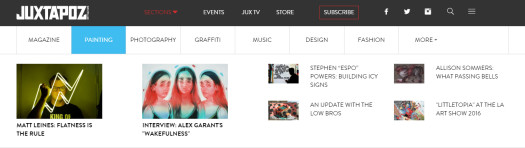
Navigating Juxtapoz.com now is a much more satisfying experience. The design is graphic and clean, with a stationary header that allows for easy access to the site’s many links. At the top of the homepage runs a page-wide image carousel drawing attention to clickable featured articles. A red box outlines the link to “subscribe” and works as effectively as the original webpage’s paragraph-long advertisement with much less effort. The only web element that seems to have (almost) withstood time is the distinctive text logo.

Snapshot of Juxtapoz homepage

Neatly organized boxes of various sizes showcase other posts by date; they also include images and section tags. The website scrolls indefinitely with the articles being continually tiled down the page and occasional page-wide banners emphasize featured content. Being an art magazine, the website is very image heavy, which adds to its visual appeal. With the many colorful and varied images, the site manages to avoid being jarring by using ample white space and simple, black, san serif type.

The design is clean, but it does become repetitive with the same banners reoccurring frequently. Also, the chronologically organized articles are grouped by common sections and seem randomly placed. The links offered by the stationary header, however, provide a more logical grouping of articles with a convenient drop down menu and several links for a quick selection of posts based on category. A search bar is also found in the header to locate posts based on key words. This allows for easy navigation through the website.

Snapshot of Juxtapoz dropdown menu

The current Juxtapoz website does contain ads, but they are not overwhelming or intrusive. Most of them are banner ads between the tiled articles and some occasionally appear along the sides. Video ads thankfully stay muted unless clicked. They also do not appear to affect the websites load time or hinder its functionality in any way.

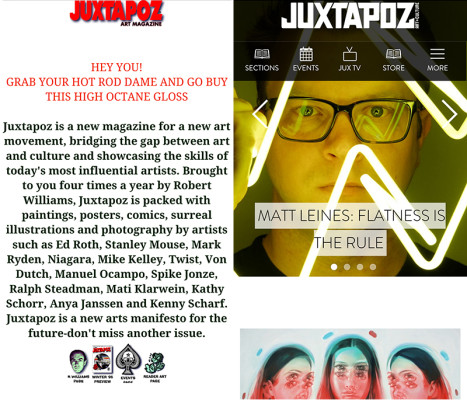
The mobile version of the website is much the same as the desktop version with a stationary header with links, featured article carousel, and continuous scrolling. For easier use however, the header includes icons for each link and more stacked links. The article tiles are also condensed to a single column. The mobile version of the original website is very much the same as the desktop version, except fit to a smaller screen.

Old and new mobile site

In terms of accessibility, many elements allow for simple navigation regardless of disabilities. Clickable pictures and icons change transparency or color to be easily identifiable as links. The text is also bold and legible. Not all of the website’s elements are entirely accessible, however. The images are not accompanied with specific, descriptive captions that would be beneficial to those who are visually impaired. The website is also only navigable by using a mouse and not conducive to keyboard-only use. Overall, however Juxtapoz’s website succeeds in being well-organized, aesthetically pleasing, and very usable to the majority of its visitors.

Introducing Jessica!

About Jessica

As a child, I grew up wanting to be an artist (as well as a pet owner, until I realized that wasn’t a lucrative career path). For over twenty years, I spent countless hours drawing, painting, sculpting, collaging, and precariously using power tools in pursuit of my passion for art. I chose to study Fine Art and Creative Writing with little foresight into how difficult it would be to make a living out of that in the real world. After college, I worked as an art instructor for three and a half years, teaching Bob Ross-esque painting techniques to children and inebriated adults who acted like children; I also freelanced as an artist and English tutor as a means of making due. But even with multiple jobs, I still wasn’t making enough to live comfortably. I then decided it was time to try something new. As an undergrad, I studied abroad in New Zealand for half a year having never visited previously. During my time there, I went skydiving and bungee jumping without dying, so I figured I could move to Boston abruptly, also having never been here and be okay (I now think the cold might actually kill me). I’ve always been willing to put myself in risky and new situations for the sake of personal growth, and that’s why I’ll rock at Emerson.

What Jessica hopes to learn

During the course of this class, I hope to learn several new things as I am very unfamiliar with electronic publishing and what it entails. First and foremost, I hope to learn how to code e-books, as my coding knowledge only extends as far as changing font colors on my Xanga (circa 1999). I also hope to learn about Search Engine Optimization and how to use it for successful marketing and outreach. I’d like to be able to understand the basics of building a website, by either using and manipulating templates, or entirely from scratch. In line with that, I hope to learn more about how to generate viewer interest and subscribers to blogs, online publications, podcasts, etc. and how to sustain it. I also hope to understand ways in which these ventures can be financed and what it takes to be profitable. I believe it is essential to be knowledgeable in all these aspects in order to be successful in today’s publishing market, especially with the continued and increasing demand for digital content.