Brothers Hank and John Green created the VlogBrothers back in 2007 (though it was then known as Brotherhood 2.0) as a yearlong experiment to see if they could communicate with each other solely through YouTube videos. Their videos started gaining the attention of the YouTube community when a song Hank wrote for a segment called “Song Wednesday” called “Accio Deathly Hallows” reached the front page. Now, the channel has over 2.7 million subscribers!
What started as just a hobby has now expanded into a brand. Fans of the VlogBrothers call themselves Nerdfighters and rally around the slogan DFTBA (Don’t Forget To Be Awesome). John has made a name for himself in the publishing world for his bestselling Young Adult novels The Fault in Our Stars, Papertowns, Looking for Alaska, and An Abundance of Katherines – the success of which he attributes to his Nerdfighters. The pair have also created a yearly YouTube convention called VidCon, Hank started a record label called DFTBA records, and they now host and produce various other YouTube shows such as SciShow and CrashCourse.
There are many reasons this channel has reached great success, one being the passion of its cohosts. The brother’s enthusiasm and energy radiates through every episode and challenges its viewers to think outside the box on a variety of “nerdy” topics. Whether it be a wacky new song that Hank wrote about Anglerfish, an educational segment about Catcher in the Rye, or political commentary on “Why Does Congress Suck?”, there is something for everyone. Sometimes the brothers even issue punishments to each other. In one episode John even gets an inkless tattoo, a punishment created by both Hank and Nerdfighters. This is just one of the many examples of how influential this community can be!
No matter the variety in topic, each episode hinges on one important thing: creating a dialogue and education. In a recent TED Talk, John Green compares YouTube to a classroom where the host is the instructor, the viewers are the students, and the comment section is an area for the “students” to create dialogue, ask questions, and participate in intellectual engagement. He says, “Finding these [YouTube] communities has reintroduced me to a community of learners and has encouraged me to continue to be a learner even in my adulthood.”
The channel has changed a lot over the last 9 years, specifically with the production quality and the topics of each episode are a little more focused, but the humor and quirkiness have remained the same – there are just more people watching.
Tell me a bit about your podcast! The main players, the message you’re trying to send to your listeners?
My podcast is called Reflections of Three Broke Travelers and features Tarek Elamine, Alex Papo, and myself. The main message of our podcast is for young people to really take advantage of experiencing someone else’s culture and way of life with advice on how to not be an ignorant traveler. Between the three of us, we have travelled to a wide range of countries across the world and we’re excited to share our advice to those that want to get a deeper experience from their travels beyond the “touristy” sites.
Why are you the perfect person to be qualified to produce this podcast?
Collectively, the three of us have traveled to a majority of countries around the world and have had unique experiences at each location. After hosting a radio show together for three years, Quantum Chaos on 88.3 WQRI, we’re not afraid to debate each other’s point of views and create a deeper dialogue. While we are just three voices and cannot possibly cover every individual’s experiences, we hope listeners will respond to our honest opinions and see that there is more than one way to travel.
How will this podcast differ from the hundreds of podcasts out there?
I think our chemistry will be what draws listeners to our podcast over any other about travel! We work well together, bouncing ideas off one another and poking fun, but mostly we want to talk about travel on a deeper level. Why the American media portrays certain countries as “dangerous,” how to get the most out traveling to a new country and experiencing their way of life, and more importantly, how not to be an “ugly American.”
For the listeners, what can they expect as this podcast grows? What plans do you have for the evolution of the podcast? (types of episodes, themes, ways of serializing the podcast, etc.)
Our first episode discusses travel as a whole, it’s really our way for listeners to get a feel for our style. As the show progresses we will focus in on more specific countries and regions of the world. Each episode will talk about the countries background and some tips to getting the most out of your time there.
For example, Alex and I have even traveled together to some European countries and found that we both travel in similar ways. For example, while in Rome we walked for an hour down side streets until we found this small restaurant tucked in an alley and had one of the best meals of our lives! These hidden gems are the kind of thing one can expect to hear about in our podcast! Posted inBlog Challenges, Podcasting | Taggedinterview, Lindsey Yanow, Pubcast, startup, Three Broke Travelers | Leave a reply
A TED Radio Hour podcast review on three different platforms:
PW Loves TED Radio Hour
Everyone knows about TED. No, not that guy from HR, but Technology, Entertainment, and Design. This amazing nonprofit organization brings together a panel of experts to share their revolutionary thoughts and ideas. What’s even better is there’s a podcast version of it available on your computer and mobile devices! Hosted by Guy Raz, NPR’s TED Radio Hour takes the best parts of TED and molds it into NPR’s interview structure. If you love watching TED Talks, but don’t have the time to listen to a whole playlist or watch the video, this podcast takes 3-5 popular TED Talks of roughly the same theme and interviews each speaker about their knowledge in that area beyond what was talked about in their presentation. And as a bonus if you watch online, there are even links to those full TED Talks to watch! Even if you don’t have time to listen to the full hour, the podcast is broken up into clips for each speaker! Hands down the best podcast for learners on the go!
Twitter Chatter
I love learning something new every day with @TEDRadioHour! Who knew that even Sting struggles with writer’s block? #learneveryday
Have you ever thought, how can something I listen to for free make money? Well, so have I. But there are actually some really successful podcasts out there that are also big money makers. In 2014, “This Week in Tech” earned $50,000 per episode!1 Let me introduce to you nine tried-and-true methods of monetizing a podcast:
1. Advertisement
An oldie, but goodie. There is a lot of debate about whether or not ads are the best choice for podcasters. On one hand, viewers can get annoyed with ads and on the other, they work. Luckily for you, there are easy ways to make ads work in your favor. The first, select advertisement that fits with the theme of your podcast. Viewers don’t like to feel like they’re getting tricked by advertisers, so pick a relevant product to feature. Second, don’t overload your podcast with ads – pick two ads maximum per episode. And third, don’t rely solely on ads to make your money. They’re great for starting out, but they’re not the only way to go. Mix and match with other means.
2. Sponsorship
A step up from ads is to work with a sponsor. The tricky part is choosing the right one for you. Don’t just settle for any sponsor that happens to knock on your door. This relationship is meant to be two ways and you don’t want to lose listeners because they don’t trust the reputation of your sponsor. If you’re worried about not getting sponsored because you don’t have billions of viewers (yet!), fret not. Today in digital marketing, it’s not just the size of one’s audience that matters, but about how many people are engaging with your product – in this case, your podcast. Sponsors are more willing to invest money into a product that leaves a larger impression or CPM.
3. Affiliate Codes
The biggest trend in digital marketing is affiliate codes. It’s the “I’ll scratch your back if you scratch mine” approach. The code encourages listeners to go purchase a product on a particular site at an exclusive discount (courtesy of you), and in turn, you make easy money that is tracked through how many people actually use your code. Much like the relationship you make with a sponsor, an affiliate code gives the company you’re joining with your stamp of approval, so be careful who you choose to join up with. If there’s a particular company that you know for certain your listeners would purchase from and they don’t offer an affiliate code, you can also reach out to that company and see if they would be willing to create a specific offer code just for you!
4. Donation
There’s no shame in asking for help every now and again, even popular podcasts like Serial asked for donations for their second season! The catch with relying on donations to monetize your podcast is that you need a strong fan-base in order to bring in significant money. So if you’re looking to launch your popular podcast to the next level, donation requests might be the solution for you!
5. Crowdsourcing
If you just read number four and felt your heart sink because you realized your brand-new podcast may not get donations, there is still hope for you! The solution is crowdsourcing. Major sites like Kickstarter, Crowdfunder, Indiegogo are designed to help new, great ideas get the funding they need to launch their business. Podcaster Roman Mars used Kickstarter to help produce his show “99% Invisible” and raised $170 thousand in 2012 and a year later over doubled that with $375 thousand.2
6. Partially Free Shows
If you’re looking to entice listeners into paying for a portion of your podcast, you can allow for an allotted amount of time to be free and if listeners wish to continue listening then they need to pay. The drawback is this method could turn away viewers who come to your podcast expecting it to be free, but could be good for a story-type podcast.
7. Paid Subscriptions
Similarly, paid subscriptions can work by providing exclusive content to paid subscriptions. The key is to create a subscription package that makes it worth the listener’s money to invest. It also helps if your podcast has a strong viewership to start with. You can offer exclusive episodes, special deals, access to archived episodes, or membership to an online community, among other incentives.
8. Apps
Complimentary apps can also lead your loyal fans to exclusive content. It works in a similar way that a paid subscription does, but focuses on the mobile platform. All you need is something worth paying money for. Podcaster Elsie Escobar created a complimentary iPhone app for her podcast “Elsie’s Yoga Class Live and Unplugged” for $3.99. The podcast is completely free, but the app allows listeners to download PDF versions of her yoga classes.3
9. Live Show
This is more of a late game strategy after building up a large audience. The concept is simple: generate enough interest in your audience to host a live version of your podcast and charge money to view. You can also charge a fee to listen to the taping of the live show (if it isn’t live normally) for those who may have been unable to attend the event.
And that’s it! Through mixing and matching these various methods, you’re ready to bring in the big bucks with your podcast!
Writing code is truly like learning a new language. And from personal experience, the best way to learn a new language (other than practice, of course) is to seek out guidance from those more knowledgeable. Luckily for me, my computer-genius older brother happened to be home this past weekend and I managed to guilt him into helping me navigate the gibberish of code. Surprisingly, I knew a little bit more than had originally given myself credit for. It was the equivalent of Spanglish – basic English with the few words or phrases that I knew tossed in.
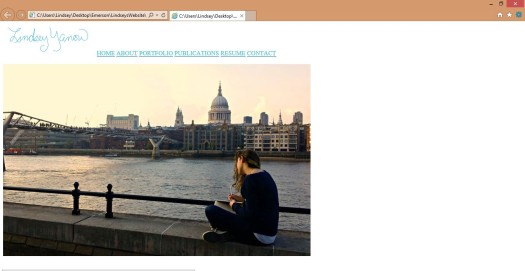
One of the greater problems I faced was trying to get the computer to recognize where my photos were coming from. Initially, it was linking from my desktop, which creates some obvious problems because not everyone will be using my desktop to view my website. We corrected this by creating a new folder just for my website entitled “Lindsey’s Website” with a specific folder within called “images.” This created another issue because of the formatting. The names of all my images and folders had punctuation or spaces in the titles that definitely confused my computer. To resolve this issue, we renamed everything, and voila! That’s what fixed it.
I also learned through this process, with the help of my brother, that eventually when you get it right, you don’t need the long list of folders within folders that your images are in. All we needed was the direct folder it was in, called “images.”
You might notice another addition made to this code: alt=”LindseyTestLogo”. When we experienced all these problems with my images not showing up, my brother taught me this neat little trick that places descriptive words of what the image is supposed to be where the broken link is.
Though I am far from being an expert in coding or computers, and my website isn’t exactly where I want it to be yet, I am extremely proud that I managed to get this far. Bottom line: ask for help when you need it and don’t use spaces or punctuation to label things.
The first digital existence of the New Yorker appeared at the end of 1998 featuring little more than a search bar where users could click on the article they would like to read and press “Go.” Even this search bar isn’t very user-friendly as it doesn’t allow for readers to type in key words and restricts them to just select articles. As for ads, there is a changing banner running along the top that says things like “I Eat Out __ Times per Month”, “Tell Us Your Age”, and “Do Men Find Successful Women Sexy?” Thankfully, everything about the original website has changed since!
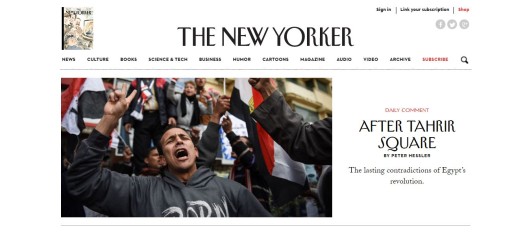
Fast-forward to present day and the website’s design is as sleek and classy as the magazine’s reputation. The website is predominately white with black and red text, but the colorful images connected with articles bring some life to it. The eye is initially drawn to a large photo featuring that day’s headline story with the headline, author, and deck to the right. Underneath the large New Yorker logo there is a link bar covering a variety of categories such as News, Culture, Books, Science and Technology, and Cartoons. Even Audio and Videos get their own link! By separating them from the rest of the content, users are allowed to choose if they want this kind of experience without forcing it.
A banner advertisement runs along the top of the page, one in the middle, and one the bottom with at least three blocks of ads on the right hand side. Half of these ads are for the New Yorker and the rest for outside companies. With such a low number of ads on the main page and the videos stored separately, the load time is very low. Users are lead to social links if they wish to share or comment on the articles, but what’s missing is the ability for users to comment directly on the site.
On mobile, the links fold into a hamburger bar next to a smaller logo. The image connected to the headline story sits just below the logo, still making it the first thing the user sees. There isn’t much variety to the layout of articles in the mobile version. On the left hand side there is a small image and on the right side there is the headline, author, and the deck.
The New Yorker website has come a long way since 1998 and has definitely changed for the better! It wasn’t until spring of 2007 that the website started to resemble what it is today and even since then it has improved greatly! Not only is today’s website clean and readable, but it is user-friendly and easy to navigate. For a brief time in 2000, the New Yorker experimented with color for the first (and last) time. If I could recommend one feature of the old New Yorker to return, it would be that little bit of color.
My name is Lindsey Yanow. I’ve lived in New England for most of my life so I’m very familiar with adapting to temperamental weather conditions. I’m a major bookworm and have been since I was little when I maxed out my library card for the first time. I also like to write short fiction, which I studied in undergrad along with graphic design and arts management. After graduate school, I hope to work in children’s publishing because I love the idea of shaping young minds through reading and all the psychology related to that. Overall, I just want to make people happy. I’m a super-optimist to the point where some people find it annoying, but if you catch me smiling, I swear it’s genuine.
I am currently an intern for the marketing department of a children’s publishing house, Barefoot Books, and I’m interested in learning how to be a better marketer in the digital world. Through this course I want to learn:
How to jump the curve of social media trends such as linking, hashtags, etc.
How to gain a following from people who may not know you or your company and make money off “free” sites.
How to use basic HTML and CSS so that I know how to make my own website and troubleshoot problems should they arise.
Why some e-books cost the same as the print book and some cost less.
How to design an e-book.
I don’t know much about the digital publishing industry, but my desire to learn and use the creative skills I’ve acquired over the years to gain new skills is why I will rock Emerson’s publishing program!

 100vw, 264px”></p>
</div><!-- .entry-content -->
<footer class=)

You must be logged in to post a comment.